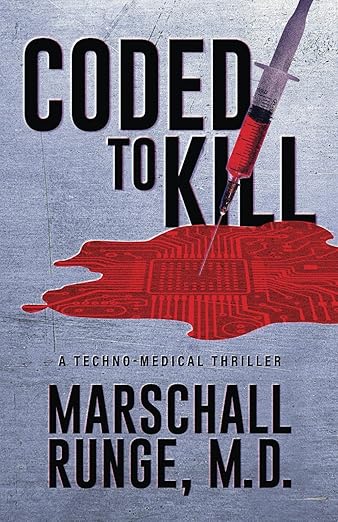
The premise
After a decade of development, Drexel Hospital's new electronic health records system is about to become the national standard. Once activated, it will house the real-time medical record of every American — a single, integrated, beautifully engineered system of unprecedented scale.
A former NSA operative sees it differently. He sees a tool for unimaginable power.
Only a loose-knit group of hospital employees with conflicting loyalties stands between him and that power. None of them is who they appear to be. None of them can do this alone.
"The system designed to save your life can become the weapon used against it."
Perfect for
- Readers of Robin Cook and Michael Crichton — medical-technical thrillers grounded in real science
- Anyone uneasy about who has access to their medical records
- Healthcare professionals interested in fiction that gets the medicine right
- Readers of The Andromeda Strain, Coma, or State of Fear
Praise
"A beautifully written, complex mix of medical drama, espionage story, and hi-tech skulduggery, Coded to Kill is a thrilling read under the guidance of someone who knows what he is talking about, and never fails to enthrall with its detail and deft plotting."
"Dr. Marschall Runge gives us both a heart-stopping thriller and a searing indictment of the degree to which technology has sapped the soul of medicine and handed it to the technocracy."
For book clubs & reading groups
Six questions to discuss after reading. Useful for book clubs that pair fiction with current events, or healthcare-leadership cohorts looking at the policy questions inside the thriller.
- The novel's central premise — a single national EHR system — is more plausible now than when it was written. Which of the book's risks feel most realistic to you?
- The antagonist isn't a hacker; he's an insider with the right access. How does the book change how you think about who to trust with medical data?
- Several characters have conflicting loyalties: to their institution, to patients, to colleagues. Which character's choice did you find hardest to understand?
- Compared with Robin Cook or Michael Crichton, where does this book sit? What does it gain by having an author who has run a hospital?
- The book treats "the system" as a character. What does that frame let it say that a single villain wouldn't?
- The same author writes nonfiction (The Great Healthcare Disruption). What does the fiction tell you about the nonfiction's argument, and vice versa?
Where to buy
Available in hardcover, Kindle, and audiobook at: